Why the La Paz Region Is One of the Best Places in the World for Solar
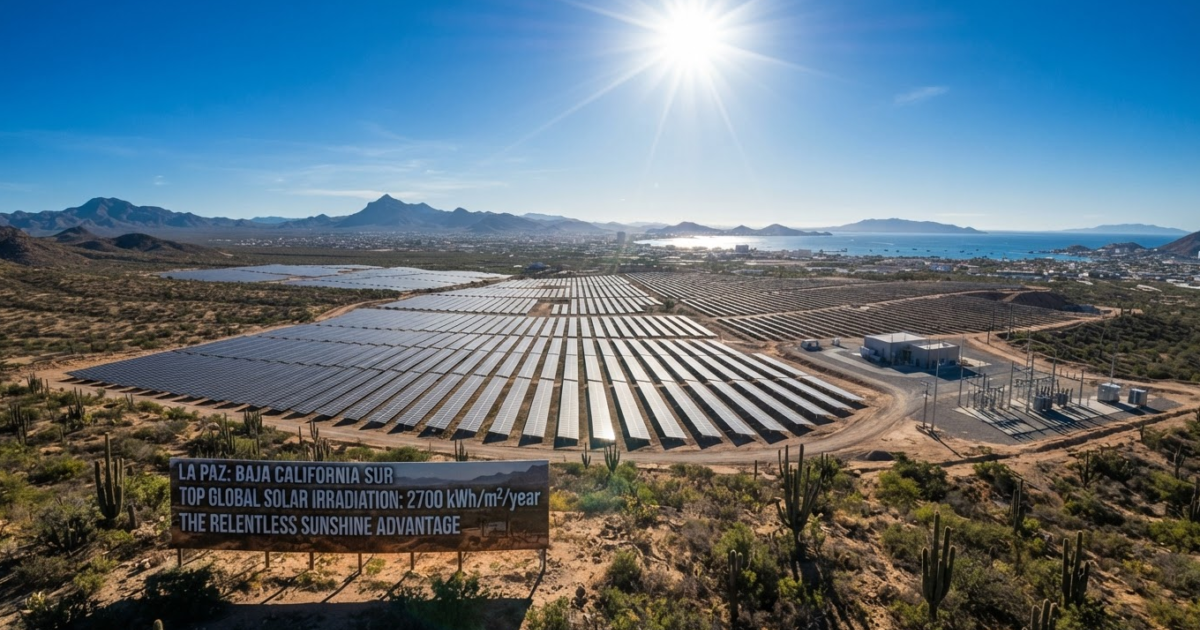
Baja California Sur receives an average of 6.19 kWh/m² per day of solar energy across the year — a figure drawn from peer-reviewed analysis of nearly two decades of data. To put that into context, that places our state in the same tier as the most sun-drenched territories on Earth. Namibia, widely cited as having the world's best national solar resource, averages 6.3. Saudi Arabia comes in at 6.16, Egypt at 6.07. The American Southwest — Arizona, Nevada, the deserts where US utilities pour billions into solar farms — tops out around 6.2. La Paz sits comfortably among them.
It is worth being precise about the claim. La Paz is not the single best place in the world for solar; that distinction belongs to Chile's Atacama and Altiplano, the highest-irradiance surfaces on the planet. But "one of the best" is not marketing language here — it is a defensible statement of fact, and it beats Mexico's already-high national average of 5.5 kWh/m² per day.
For the many residents of La Paz, El Centenario, Todos Santos, El Pescadero and the surrounding communities who arrived from further north, the comparison is even more striking. A rooftop in the US Midwest sees closer to 4 kWh/m² per day. The Pacific Northwest and much of Canada sit near 3.5. A solar panel installed in El Comitán will simply produce far more electricity, every year, than the identical panel would have on a roof back home — often 50 to 70 percent more.
Why the peninsula is so exceptional
The reasons are geographic, and they compound. La Paz sits at roughly 24 degrees north, in the heart of a desert peninsula. Deserts make outstanding solar territory for a simple reason: clear skies. Clouds and rainfall are what steal solar production, and Baja California Sur sees precious little of either. The dry air also carries very little water vapor, which means less of the incoming sunlight is absorbed or scattered before it reaches a panel.
Just as important is consistency. In high-latitude regions, winter output collapses — short days and low sun angles can cut production to a fraction of the summer figure. The Baja peninsula shows unusually low seasonal variability. Winters here remain highly productive, which means a system sized for the year keeps earning its keep in every season, rather than having reduced output for several months of the year.
Why the resource matters more here than the number suggests
A strong solar resource is only half the story. What makes the La Paz region genuinely one of the best places in the world to own solar — not just to measure it — is how the sunlight lines up with the local economics.
Two things set our market apart. The first is the CFE's DAC tariff. Households that cross their consumption threshold are pushed into a bracket with no government subsidy, and electricity bills that had been manageable suddenly become punishing. In a climate where air conditioning is not a luxury but a summer necessity, a great many homes here cross that line.
The second is timing. Air-conditioning demand in La Paz peaks in the hottest, sunniest months — precisely when a solar array produces the most. The load and the generation rise together, hour by hour and season by season. In much of the world, solar output and peak demand are out of sync; here they move in lockstep. That alignment is exactly what makes solar self-consumption so effective in this market: the panels are working hardest at the very moment the meter would otherwise be spinning fastest.
What it means for a home in this region
Put the pieces together and the picture is clear. A world-class solar resource. A desert climate that delivers it consistently, year-round. An expensive electricity tariff that punishes exactly the summer usage this region cannot avoid. And a demand curve that peaks in perfect step with the sun.
There are places on Earth with slightly more sunlight than La Paz. There are very few where the sunlight, the climate, and the economics align this well for a homeowner. That combination — not any single number — is why the La Paz region is, in every sense that matters to a resident, one of the best places in the world for solar.
Ready to make the switch to solar?
Explore Residential solarWe install in: La Paz · Todos Santos · El Pescadero · Centenario