The DAC tariff explained: when solar makes sense for you
What the DAC tariff actually is
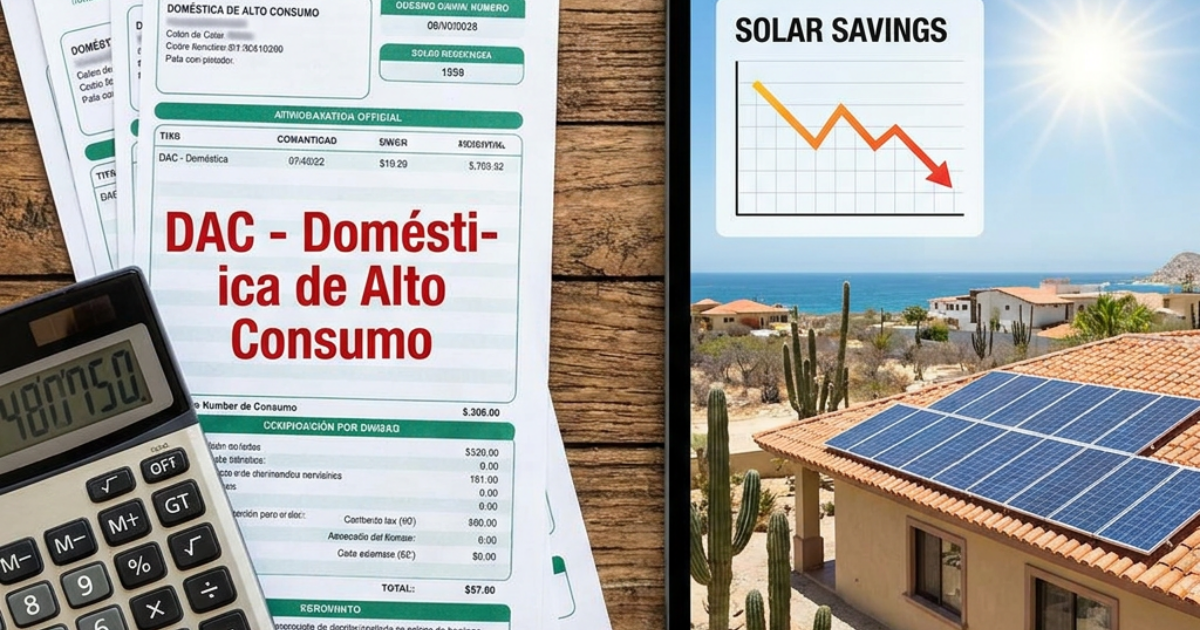
Mexico's residential electricity is heavily subsidized — but only up to a point. CFE classifies homes into base tariffs (1, 1A–1F) by summer climate, and each tariff has a monthly consumption limit. Cross that limit as a sustained average and CFE reclassifies your service as DAC: Doméstica de Alto Consumo. In DAC you lose the federal subsidy entirely and pay a single high rate per kWh plus a monthly fixed charge. A DAC bill can run three to four times what the same consumption would cost under a subsidized tariff. DAC isn't a fine or a billing error — it's the tariff system working as designed, withdrawing the subsidy from the highest-consuming households.
How BCS households end up in DAC
Most of Baja California Sur — including La Paz and the surrounding zones — is on tariff 1E, which applies to regions with summer average temperatures of 32°C or more and runs its summer season from May through October. The DAC threshold for tariff 1E is a 2,000 kWh monthly average, measured over a rolling 12-month period — not a single high bill. That matters in both directions: one brutal August of air conditioning won't push you into DAC by itself, but a sustained pattern will, and because the average moves slowly, a few high months keep weighing on your classification long after temperatures drop. Some accounts in the region sit on tariffs 1B or 1C with much lower limits (400 and 850 kWh respectively), so the first step is always reading the "Tarifa" line on your own CFE bill — your limit depends on it.
What DAC costs in Baja California Sur
As of January 2026, the DAC tariff in BCS carried a fixed monthly charge of $142.25 MXN plus $6.917 MXN per kWh in summer and $5.453 MXN per kWh outside it. Compare that with tariff 1E's subsidized summer blocks, where the first 300 kWh cost $0.809 per kWh and consumption up to 750 kWh cost around $1.00 per kWh. On top of the federal subsidy, BCS households on subsidized tariffs have received an additional seasonal support of roughly 40% during the summer months — a benefit DAC accounts are explicitly excluded from. Put together: a household billing 1,500 kWh in a summer month pays a fraction per kWh of what a DAC household pays for the same energy. DAC rates are updated monthly by region, so treat these figures as a snapshot and check your current bill for exact rates. [Rates above verified Jan 2026 — re-verify at publish date.]
How solar changes the DAC math
Here's the mechanism that makes solar uniquely effective against DAC: under CFE's net metering scheme, your panels' production is subtracted from your consumption before CFE bills you. The number on your bill — and the number the 12-month DAC average is built from — is your net consumption. A home that uses 2,400 kWh a month but generates 1,800 kWh of it bills only 600 kWh, comfortably under the 1E threshold. You keep living the same way — air conditioning, pool pump, all of it — while the number CFE evaluates drops. Efficiency measures and behavior changes can nibble at consumption; solar restructures it. For how the billing and credit rollover works in detail, see our guide on how CFE net metering works.
Getting out of DAC — and staying out
Exiting DAC is not automatic. You need to bring your 12-month average back under your base tariff's limit and then request reclassification from CFE — they won't move you back on their own. Because the average is a rolling window, the exit takes patience: your high pre-solar months keep counting until they age out of the window. In practice, a correctly sized system starts pulling the average down from the first billing cycle, and most households cross back under the threshold well within the first year. Once reclassified, the same system that got you out keeps your net consumption low permanently — which is why solar is a structural exit rather than a temporary fix like a summer of rationed air conditioning.
When solar makes sense for you — and when it doesn't yet
If you're already in DAC, the case is close to automatic: every kWh you generate replaces one billed at the full DAC rate, and paybacks are the shortest of any residential scenario. If you're near the threshold — watching your 12-month average creep toward your tariff's limit — solar is preventive: it costs less to stay out of DAC than to climb out of it. Where the case is weaker is at genuinely low consumption, deep in the subsidized blocks: the subsidy you'd be offsetting is exactly what makes those kWh cheap, so payback stretches. The honest way to decide is with your own CFE bill history: your tariff line, your 12-month average, and your distance from the threshold. That's the analysis we run in every quote — bring your last few bills and we'll show you the numbers, not the pitch. For the full economics, see our guide on solar payback in BCS.
Ready to make the switch to solar?
Explore Costs, savings & financing