Bunker Fuel Production Has Fallen 33% this year. Here's What It Means for Electricity in La Paz
What happened: a one-third cut, on purpose
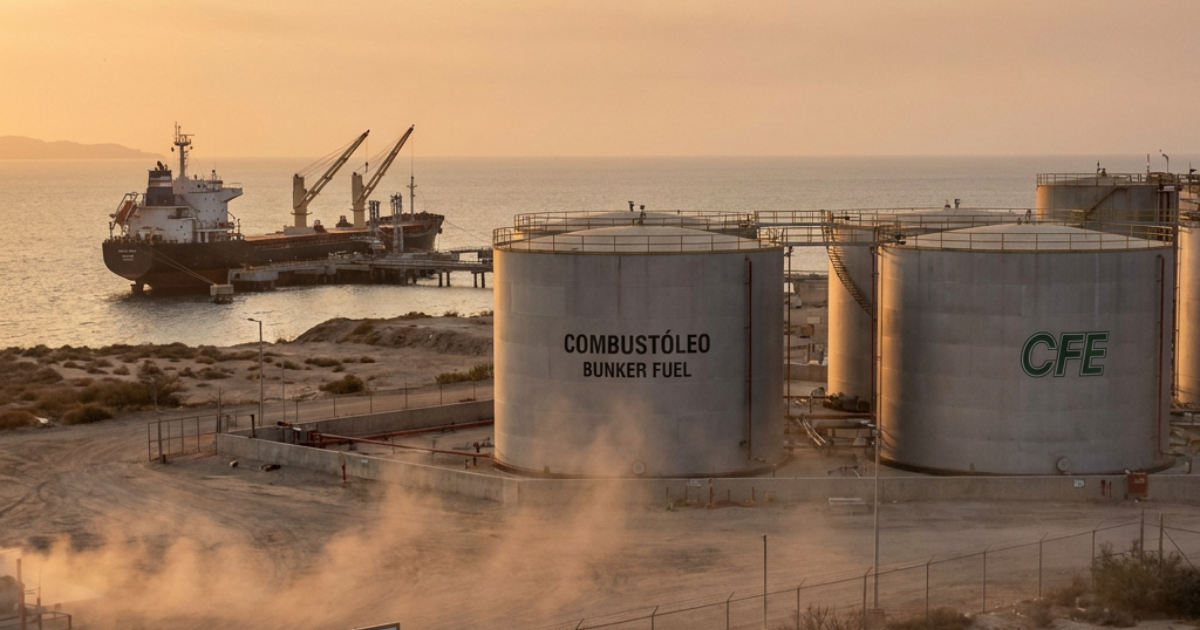
In its first-quarter 2026 report, Pemex announced that combustóleo (bunker fuel) production fell 33.1% — from an average of 240,000 barrels per day in 2025 to 161,000 barrels per day. This wasn't an accident or a supply failure. Pemex's refineries are being upgraded to squeeze more gasoline, diesel and jet fuel out of every barrel of crude, which means less residual fuel oil left over. Gasoline production rose 29.6% in the same period and diesel rose 69.9%.
For most of Mexico, this is good news: bunker fuel is the lowest-value, highest-polluting product a refinery makes, and the country has been trying to make less of it for years.
For La Paz, the picture has another layer.
Why this lands differently in Baja California Sur
Baja California Sur runs on an isolated electrical grid. There is no connection to the national system — no cable across the Sea of Cortez, no backup from the mainland. What gets generated here is what gets used here.
And most of what gets generated in the La Paz region comes from two facilities that burn bunker fuel: the Punta Prieta thermoelectric plant and the CCI Baja California Sur internal-combustion plant, both just outside the city. BCS produces none of that fuel itself. Every barrel arrives by tanker to the Pemex terminal at Punta Prieta.
So the region sits at the end of a long supply chain for a fuel the country is deliberately making less of. Nobody has reported a delivery shortfall — this is not a fuel crisis. But the structural picture is clear: the national supply of the fuel La Paz's grid depends on is shrinking by design, and Pemex has stated its goal is to shrink it even further.
CFE sees the same math — and is acting on it
This isn't a problem the government is ignoring. If anything, federal investment decisions confirm the diagnosis:
CFE is building two 50 MW thermosolar plants with molten-salt storage in Baja California Sur — roughly an $800 million USD investment — explicitly to replace bunker fuel and diesel generation. Presenting the project, President Sheinbaum said that the goal is to substantially reduce the bunker fuel consumption "that greatly affects the city of La Paz." A 240 MW internal-combustion plant is also planned for Cabo San Lucas to reinforce summer capacity.
These are real projects with real budgets. The state's energy transition is not hypothetical — it's funded and underway. The only problem is that these solutions are years away.
The gap: transition timelines vs. your timeline
Here's the honest tension. The thermosolar plants are slated to enter operation before 2030. The bunker fuel squeeze is happening now. Summer demand peaks — the ones that have historically produced load-shedding and power outages in La Paz and Los Cabos — arrive every year in between.
That gap matters in two practical ways:
Reliability. BCS summers already push the isolated grid to its limits. The blackouts of recent summers weren't caused by fuel scarcity, but a grid with no external backup and aging fuel-oil plants has little margin for anything — heat waves, plant maintenance or tighter fuel logistics.
Cost. In an isolated system, generation cost is tied directly to fuel cost. As bunker fuel becomes a scarcer, deprioritized product moved over one of Pemex's most expensive delivery routes, the economics underneath every CFE bill in BCS get less favorable — pressure that shows up in tariffs over time.
There's a third dimension that has nothing to do with the production drop: air quality. Monitoring by the civil organization CERCA has recorded pollutant concentrations above permissible limits in La Paz on 241 days per year, tied to fuel-oil power generation. As recently as March 2026, local organizations were still formally documenting emissions from Punta Prieta. The fuel being phased out nationally is the same one La Paz breathes.
What this doesn't mean
Does this mean blackouts this summer? No. The production drop hasn't caused any reported supply failure in BCS and CFE has added generation capacity in the region precisely to protect summer reliability.
Does it mean CFE is abandoning Baja California Sur? The opposite — BCS is receiving some of the most significant generation investment in the country, including Mexico's first large thermosolar plants.
Does it mean electricity prices jump next month? No. Fuel-cost pressure in an isolated grid is a slow structural force not a sudden event.
What it does mean: the fuel economics underneath electricity in La Paz are shifting permanently and the official replacement arrives on a multi-year timeline. The next several summers sit inside that transition window.
The part you control
The interesting thing about this transition is that households and businesses don't have to wait for it to reach them. The same logic driving CFE's thermosolar investment — Baja California Sur has some of the best solar resource in the country and imported fuel is expensive — using distributed power generation makes perfect sense.
A grid-tied solar system removes you from the bunker fuel cost equation during daylight hours. Adding battery storage removes you from the reliability equation too: when summer load-shedding hits, your lights, refrigeration and internet will remain operational. It's the same energy transition the federal government is funding — just at your scale, and on your schedule instead of years from now.
If you're in La Paz, El Centenario, Todos Santos, or anywhere in the region and want to know what stepping off the bunker fuel line would look like for your property, that's exactly the conversation we're here for.
Ready to make the switch to solar?
Explore Battery storage & backupWe install in: Todos Santos · Centenario · La Paz